Modeling and Rendering of Multiscale Materials (PhD Thesis)
Many materials found in nature and in everyday life, such as skin, scales, feathers, hair, makeup or fabrics, owe their appearance to structures that span several orders of magnitude, from the nanoscale up to the macroscale. Light interacts with each of these levels differently, producing striking visual effects like iridescence, sparkles, sheen or anisotropic highlights. Physically-based rendering of these materials is therefore challenging: explicitly simulating light transport through every structural level is computationally impractical, while simplified models often fail to reproduce the effects that make these materials recognizable.
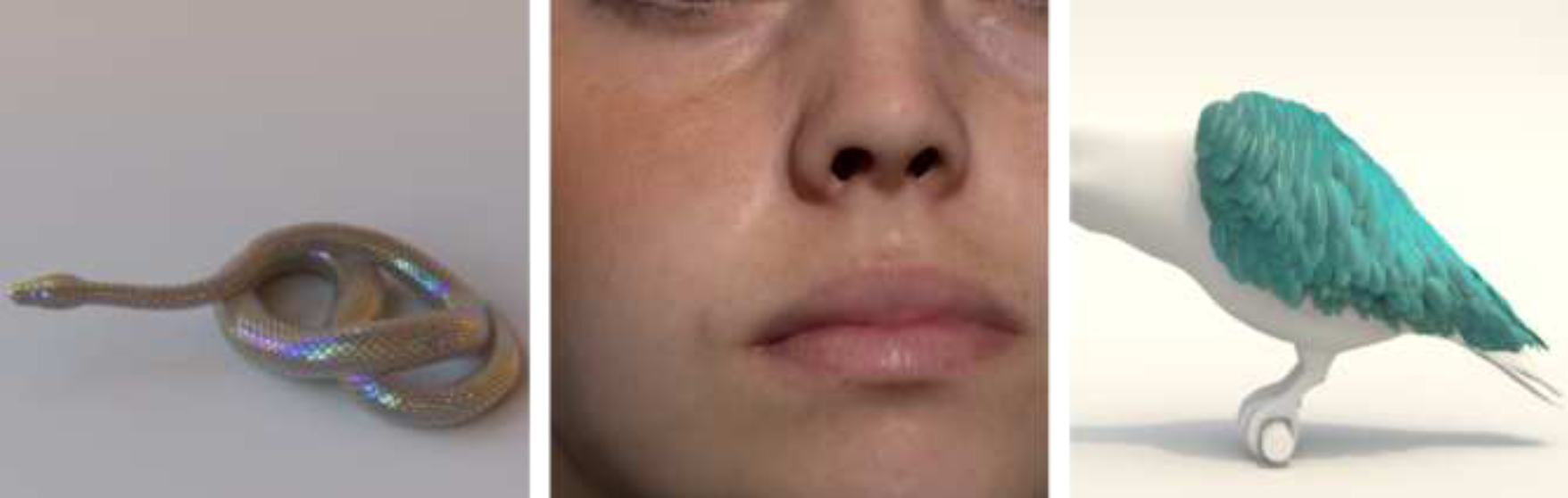
In my PhD thesis, we propose three practical appearance models for multiscale materials that trade some physical detail for feasibility, while still capturing their most prominent real-world visual effects. None of them require any precomputation:
- Snake skin: a biologically-inspired two-layer reflectance model that combines thin-film interference, responsible for the iridescent colors, with a highly absorbing layer that produces the characteristic dark tones of the skin.
- Cosmetic foundations: a multilayer model that represents makeup as a mixture of diffuse scatterers and specular platelets, reproducing matte, glossy and velvety finishes on top of human skin.
- Pennaceous feathers: a surface-based model that captures the elliptical, multilayered structure of the barbs and introduces an analytic masking term to account for the occlusion between barbs and barbules.
Publications:
- Snake Skin Rendering (CEIG 2023)
- Foundation Cosmetics Rendering (EGSR 2024, Computer Graphics Forum)
- Pennaceous Feathers Rendering (Pacific Graphics 2024, Computer Graphics Forum; poster at SIGGRAPH 2024)
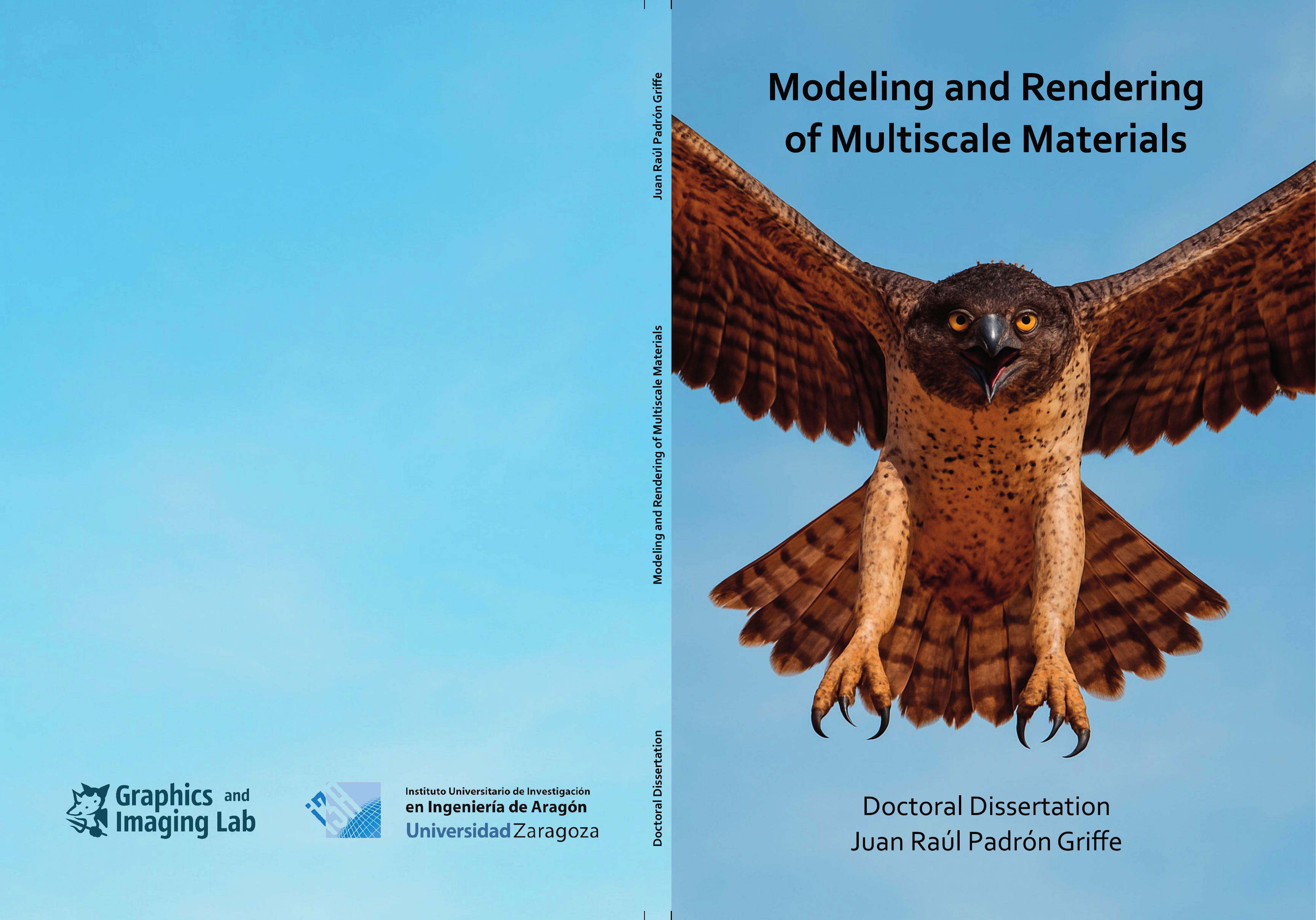
Cover Page:
Results:
Advisors: Adolfo Muñoz and Adrian Jarabo
Lab: Graphics and Imaging Lab, Universidad de Zaragoza
This work was funded by the European Union’s Horizon 2020 research and innovation program under the Marie Skłodowska-Curie grant agreement No. 956585 (PRIME).
Official Repository (Zaguan)
Full Document and Presentation