Juan Raúl Padrón Griffe

About me
I am a researcher in computer graphics at the Graphics and Imaging Lab at the Universidad de Zaragoza, working at the intersection of physically-based rendering, material modeling, and geometry processing. My research centers on multi-scale materials, from biological tissues such as human skin, scales, and feathers, to intricate human-made structures like cosmetics and granular media. Recently, I have also explored particle dynamics for sampling in computer graphics, including our recent paper accepted to EGSR 2026. My work has been published at different computer graphics venues including the Eurographics Symposium on Rendering (EGSR), Pacific Graphics (PG), and SIGGRAPH. I am currently collaborating with Zahra Montazeri's group on the representation and rendering of textiles, with a submission under review and a second project underway.

I completed my PhD as a Marie Sklodowska-Curie Fellow of the EU Project PRIME, supervised by Prof. Adolfo Muñoz and Prof. Adrian Jarabo. Earlier, during my Master of Science in Informatics at the Technical University of Munich, I conducted research on 3D scanning and neural rendering for object and face relighting, advised by Prof. Justus Thies; this followed a Bachelor of Science in Computer Science at the Universidad Central de Venezuela, where my thesis explored procedural terrain generation and visualization.

Looking for Opportunities
I recently defended my Ph.D. dissertation, Modeling and Rendering of Multiscale Materials. I am currently seeking postdoctoral and faculty positions, as well as research scientist roles, where I can continue developing my research agenda in computer graphics and computer vision for the digital acquisition, representation, and simulation of virtual worlds. If you are building a research group, have a postdoctoral or faculty opening, or simply want to discuss a potential collaboration, please feel free to reach out!

Projects

Foundation Cosmetics Rendering (EGSR 2024)

2024, Jul 01    

We started this project two years ago lead by Dario Lanza when we visit Jeppe Frisvad as part of our first secondment. The project was a collaboration between three research groups: Graphics and Imaging Lab, DTU Visual Computing Section and Media Design and Image Reproduction. Our work is going to be presented by Dario Lanza at the Eurographics Symposium on Rendering (EGSR 2024, South Kensington, London) under the title “Practical Appearance Model for Foundation Cosmetics”. We represent each individual layer as a stochastic participating medium with two types of scatterers inspired by the microscopic constituents inside foundation cosmetics that mimic the most prominent visual features of these cosmetics: diffuse scatterers responsible for the matte appearance and specular platetets responsible for the glossy looks. The implementation consists of a multi-layered material implemented inside the physically-based renderer PBRT version 4 using the Position-Free Monte Carlo formulation. The specular platelets are modelled using the SGGX microflake phase function, while the diffuse particles are modelled with a two-lobe Henyey-Greenstein phase functions. If you would like to know more about this project, then please visit the official project website Practical Appearance Model for Foundation Cosmetics. Below you can find a practical example where we add two cosmetics layers on top of a white female character’s skin (left, bottom layer): a matte finish (center, middle layer) and a red shinier layer (right, top layer).
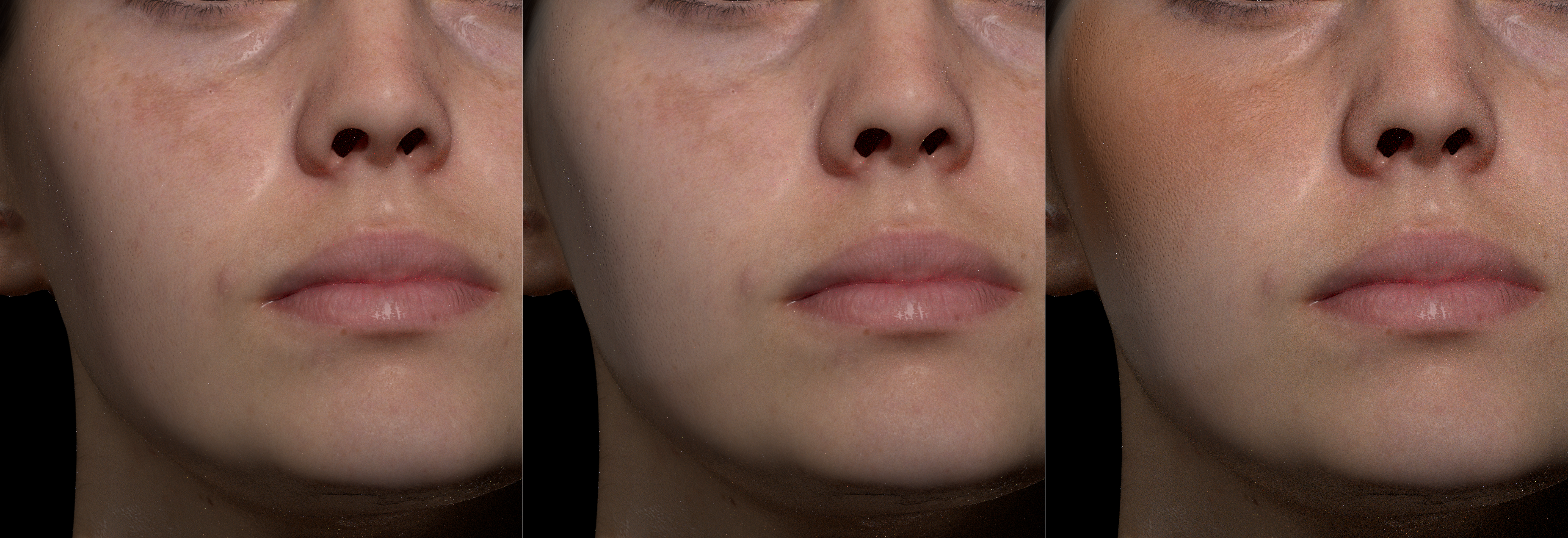
Rendering of foundation cosmetics

Team Members: Dario Lanza, Juan Raul Padron Griffe, Alina Pranovich

Github repository

Carlos Aliaga and his colleagues recently release the source code of BioSkin. An interesting technique that can predict the biophysical skin properties from RGB reflectance and we think could potentially be combined with our appearance model in order to render the cosmetic foundations on different skin types.