Pennaceous Feathers Rendering (PG 2024)
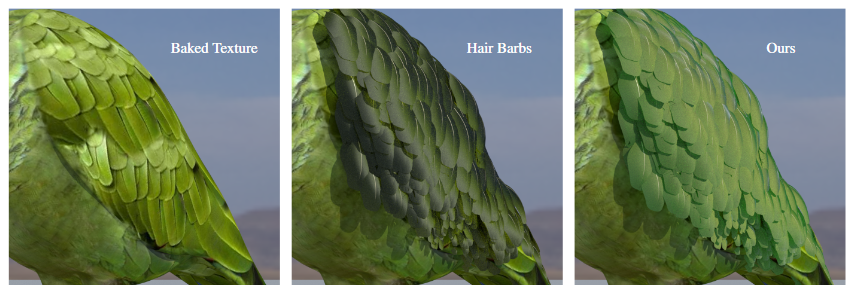
How to digitally represent feathers is a challenging problem due to their diverse and complex appearance. The appearance of a real-world feather is the result of a complex light interaction with its multi-scale biological structure including the central shaft, branching barbs and interlocking barbules on those barbs. This project supervised by Adolfo Muñoz and Adrian Jarabo at the Graphics and Imaging Lab is going to be presented by Juan Raul Padron Griffe at the 32th Pacific Conference on Computer Graphics and Applications (PG 2024, Huangshan) under the title “A Surface-based Appearance Model for Pennaceous Feathers”. In contrast to previous works, we represent the feather geometry with a 2D texture and propose an analytical masking term to accurately combine both the scattering of barb and barbules based on their relative projected areas. In addition, we consider the medulla scattering inside the barbs to approximate structural colors such as blue and green. Thanks to our masking term we can also reproduce view-dependent hue variation effects that we can see in real feathers like the Amazon Parrot feather. The implementation consists of a feather material implemented inside the physically-based renderer Mitsuba 0.6 as a feather BSDF (hierarchical structure) and pigmentation BCSDF (barb and barbules) together with a set of feathers geometries represented as 2D textures. If you would like to know more about this project, then please visit the official project website A Surface-based Appearance Model for Pennaceous Feathers. Below you can find a practical example where we apply our refletance model to a wing of feathers (right, Ours) and compare with other approaches: bird model with a baked texture from a reference photograph of an Amazon parrot (left, Baked Texture) and a hair BCSDF model for barbs (center, Hair Barbs). Modeling feather barbs with a hair BCSDF and explicit strand curves is a common practice in industry.
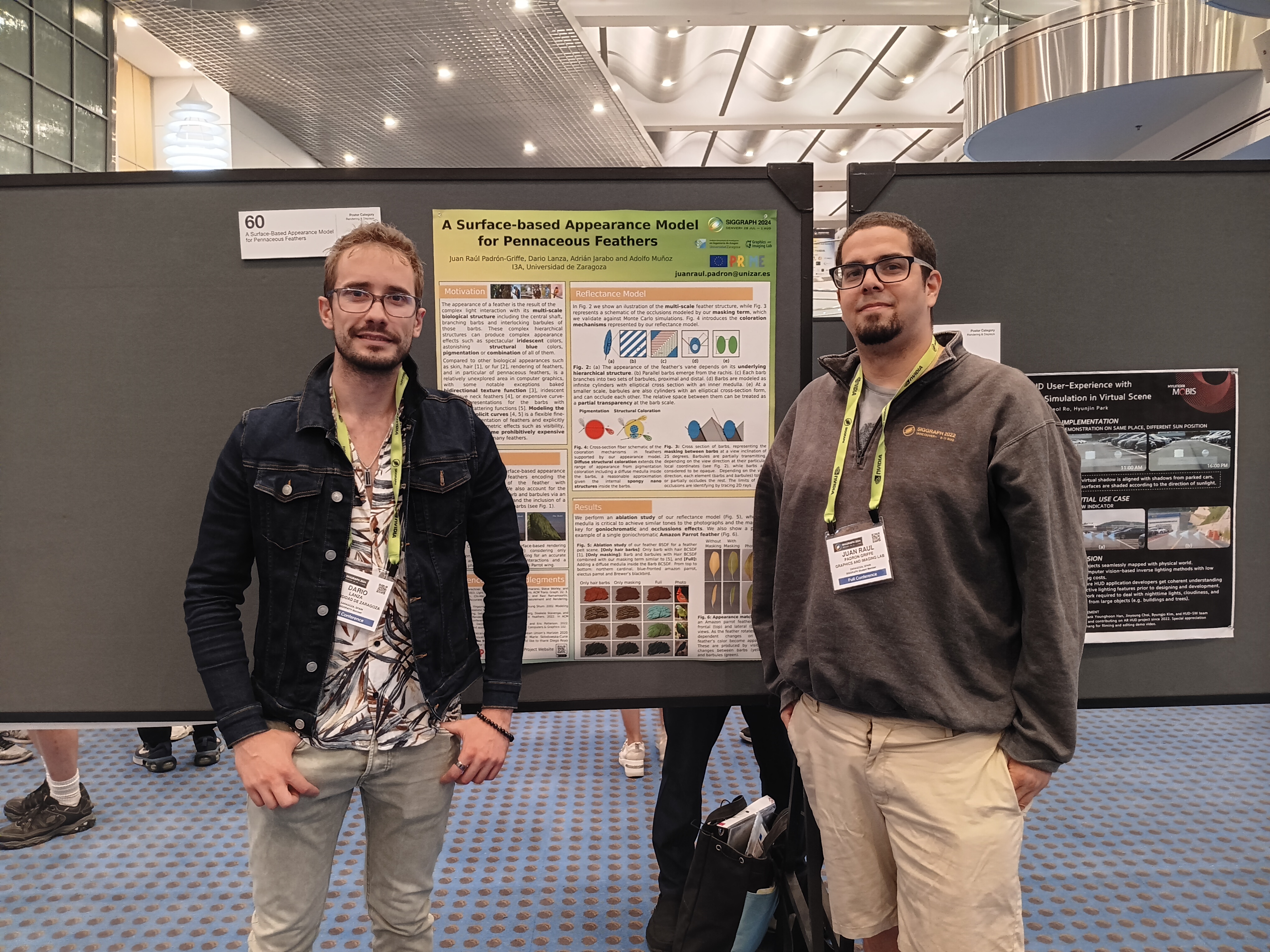
Dario Lanza and Juan Raul Padron Griffe presenting the poster at the Premier Conference & Exhibition on Computer Graphics & Interactive Techniques (SIGGRAPH 2024, Denver).
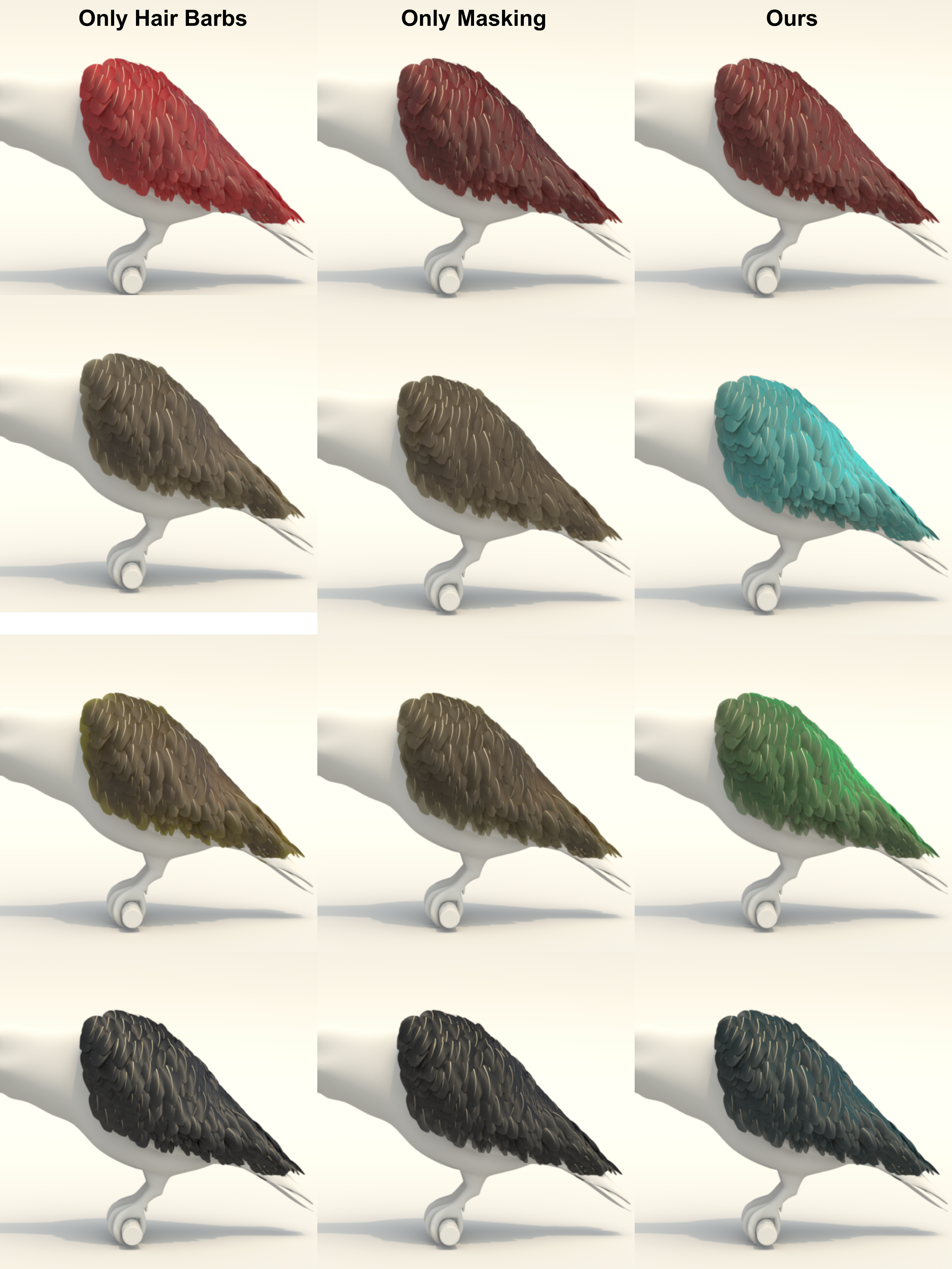
Below we also include an ablation study of our reflectance model for a feather wing scene. [Only hair barbs]: Only barbs with a hair BCSDF, [Only masking]: Barb and barbules with Hair BCSDF combined with our masking term similar to the feather microstructure shading model from previous work, and [Full]: Adding a diffuse medulla inside the Barb BCSDF. From top to bottom materials for the beautiful northern cardinal, blue-fronted amazon parrot, electus parrot and Brewer’s blackbird.
Team Members: Juan Raul Padron Griffe, Dario Lanza
If you are interested in birds and their spectacular feathers, then I would strongly encourage you to take a look at the following works: A Biologically-Parameterized Feather Model, Directional reflectance and milli-scale feather morphology of the African Emerald Cuckoo, Chrysococcyx cupreus by Todd Alan Harvey, Procedurally Generating Biologically Driven Bird and Non-Avian Dinosaur Feathers by Jessica Baron and Rendering Iridescent Rock Dove Neck Feathers by Weizhen Huang. This year a paper about deformations in feathers was presented at SIGGRAPH 2024 Modelling a feather as a strongly anisotropic elastic shell by Jean Jouve. For general information about ornithology read the bird coloration books Bird Coloration. Volume I and II by Geoffrey Hill and Kevin McGraw and visit the official websites of the PRUM Lab, Cornell Lab of Ornithology and Feather Atlas by the U.S. Fish & Wildlife Service.